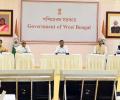
West Bengal Chief Minister Shuvendu Adhikari has directed senior officials to ensure transparency, accountability, and strict adherence to rules in governance. He emphasised the importance of honest opinions and actions for the state's development, urging officials to restart stalled centrally sponsored schemes and implement promises from the BJP's election manifesto.

The Supreme Court expressed serious concern over custodial deaths, calling it a 'blot' on the system. The court is pushing for compliance with orders to install CCTV cameras in police stations and central investigation agencies to curb human rights abuses.

The Supreme Court on Friday sought responses from the Centre, Uttar Pradesh government and others on a plea filed by a woman advocate alleging illegal detention and custodial sexual assault at a police station in Noida.

West Bengal Chief Minister Mamata Banerjee has accused the BJP of attempting to illegally include voters from outside the state in West Bengal's electoral rolls, alleging a coordinated effort to interfere with democratic rights.

The simmering tension between former Cricket Association of Bengal (CAB) president Avishek Dalmiya and the current Sourav Ganguly-led establishment came out into the open on Wednesday, with the state cricket body's top brass issuing a strongly-worded rebuttal to allegations of corruption and governance failures barely three months before its annual general meeting.

The Supreme Court has directed the Election Commission to display the names of those on the 'logical discrepancies' list at various public offices in West Bengal, addressing concerns about irregularities in the voter rolls.

The apex court has reserved its judgement on draft AIFF constitution and a hearing is scheduled for Monday.

The Enforcement Directorate conducted searches at multiple locations in Mumbai and Hyderabad as part of a money laundering investigation against Reliance Power Ltd., a group company of businessman Anil Ambani.

The Election Commission has uploaded the names of people on the list of SIR logical discrepancies list on its website following a Supreme Court order. The district electoral officers will download the list and display it on panchayat bhavans and block offices.

The CBI took over the case from an SIT following a Supreme Court order, and the investigating agency has been gathering evidence relating to the stampede that occurred during a political meeting addressed by Vijay on September 27 in Karur, Tamil Nadu. The incident had left 41 dead and more than 60 injured.

A woman claiming to be an author has alleged she was attacked by a mob in Indore while researching the Shah Bano case, but police deny the mob assault, stating the dispute was over a book contract.
An author claims she was attacked in Indore after being mistaken for a 'child lifter' while researching a book on the Shah Bano case. Police deny the mob assault, citing a dispute over the book contract.

Chief Justice of India lays the foundation for an Integrated Judicial Court Complex in Assam's Kamrup district, facing protests from the Gauhati High Court Bar Association (GHCBA) over the relocation of the High Court.

The Supreme Court has directed all states and Union territories to provide updated details on jails, including capacity and overcrowding measures, by May 18, also seeking information on women's prisons and facilities for children of female inmates.

The Supreme Court clarified that it has not ordered the removal of all stray dogs, but rather that they should be treated according to Animal Birth Control (ABC) Rules. The court heard arguments on the issue, addressing concerns about rodent populations, hospital safety, and the implementation of existing regulations.

The Supreme Court has reserved its judgment on a plea seeking passive euthanasia for a man who has been in a comatose state for over 12 years after suffering a fall in 2013. The court heard arguments regarding the withdrawal of artificial life support and the ethical considerations involved.

Actor Vijay faces intense CBI questioning regarding the tragic stampede at his rally in Tamil Nadu, as the investigation seeks to uncover the truth behind the incident that claimed 41 lives.
The appeal was mentioned before a vacation Bench headed by Justice Arijit Pasayat, which fixed June nine as the date for hearing the matter. The Bench allowed senior advocate P R Andhyrujina, who mentioned the matter, to file a special leave petition against the High Court order later in the day.

The Supreme Court on Friday dismissed a plea of Byju Raveendran, the promoter of Think and Learn Private Limited that operates ed-Tech firm Byju, challenging an NCLAT order which has mandated that the settlement of the BCCI's claim be placed before the Committee of Creditors.

The Supreme Court on Tuesday called on the Union government to enact a legal framework recognising paternity leave as a component of social security, stressing that caregiving responsibilities must be shared between both parents.

Arvind Kejriwal has written to Delhi High Court Justice Swarana Kanta Sharma, stating he will not appear in the excise case personally or through a lawyer before her, citing concerns about impartiality.
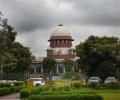
The Supreme Court of India has ruled that voluntary retirement is a distinct right of employees upon completion of the required years of service, clarifying the process and employer obligations.

The CBI has summoned actor Vijay for questioning in connection with the 2025 Karur stampede case, which resulted in numerous fatalities and injuries. The investigation follows a Supreme Court order emphasizing impartiality and thoroughness.

The Supreme Court's stay on the UGC equity regulations aimed at preventing caste-based discrimination on campuses has been met with mixed reactions. Opposition parties welcomed the decision, while some expressed concern over the implications for marginalized communities.
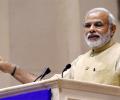
Union Minister Pankaj Chaudhary stated that Prime Minister Narendra Modi strengthened the Enforcement Directorate (ED) to combat financial crimes like money laundering and corruption, dismissing allegations of it being used to target political opponents.
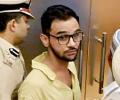
The Supreme Court has refused to grant bail to activists Umar Khalid and Sharjeel Imam in the 2020 Delhi riots conspiracy matter, citing a prima facie case against them under the UAPA. However, bail was granted to other activists in the same case.

The Enforcement Directorate conducted searches at multiple locations in Mumbai and Hyderabad as part of an investigation against Reliance Power Ltd., a group company of Anil Ambani, concerning alleged money laundering and financial irregularities.
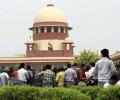
The Supreme Court has upheld a Madras High Court decision prohibiting animal sacrifice and granting limited prayer rights to Muslim devotees on the Thiruparankundram hills in Tamil Nadu.

The Supreme Court has stated it will not make structural changes to religious practices at the Bankey Bihari temple in Vrindavan, hearing a petition challenging administrative decisions affecting traditions.
The Supreme Court is scheduled to hear a plea by the Enforcement Directorate (ED) alleging interference and obstruction by the West Bengal government, including Chief Minister Mamata Banerjee, in its probe into an alleged coal-pilferage scam. The ED claims Banerjee removed key evidence during raids on I-PAC offices and the premises of its director, Pratik Jain.

The Supreme Court of India has ruled that individuals converting from Hinduism, Sikhism, or Buddhism cannot retain Scheduled Caste status, reinforcing existing constitutional provisions.

The Supreme Court will hear on Wednesday a plea filed by West Bengal Chief Minister Mamata Banerjee challenging the ongoing Special Intensive Revision (SIR) of electoral rolls in the state.

The Enforcement Directorate is investigating a Kolkata-based realty company, Merlin Group, for alleged financial links to West Bengal politicians and officials as part of a money laundering probe, seizing digital devices and documents during raids.

'We have already said that our judgment is only in the interregnum till the Act comes into play. These small things could have been easily taken care of. Anyway, we will seek the views of Justice Rao and issue a clarification.'

The Centre has directed the NCERT to review all textbooks after the Supreme Court raised concerns about 'offending' content on corruption in the judiciary in a Class 8 social science book.

Allahabad High Court judge Yashwant Varma has resigned, effectively halting impeachment proceedings initiated against him by the Lok Sabha following corruption allegations.

The Supreme Court of India will hear a suo motu case concerning victims of digital arrest, a growing form of cybercrime where fraudsters impersonate officials to extort money from victims.

The Supreme Court of India has granted permission for passive euthanasia for a 32-year-old man who has been in a coma for over 12 years, authorising the withdrawal of his artificial life support.

The Supreme Court on Monday deferred to October 13 the hearing on a plea of telecom major Vodafone Idea Ltd seeking quashing of the additional adjusted gross revenue (AGR) demands for the period until 2016-17.

The Chhattisgarh High Court has convicted Amit Jogi in the 2003 murder of NCP leader Ramavatar Jaggi, overturning a previous acquittal. Jogi has been ordered to surrender within three weeks.
